








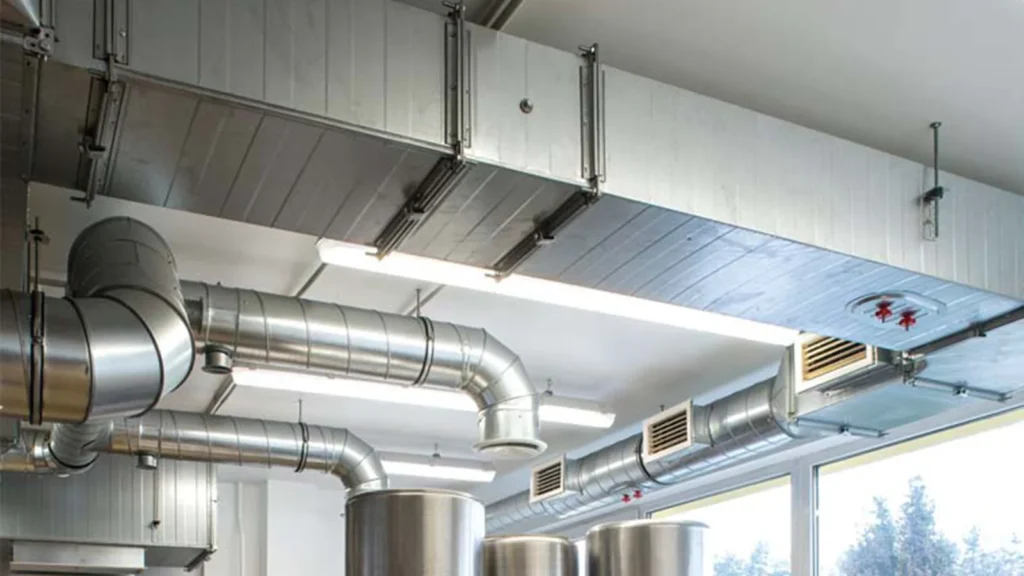
In modern building design, HVAC systems play a pivotal role in ensuring thermal comfort and indoor environmental quality. Among the various components of HVAC systems, ductwork networks distribute conditioned air throughout the building. Despite their importance, duct systems are often overlooked during design optimisation.
Role of Ducting in HVAC Systems
Duct systems serve as the primary medium for air distribution within HVAC systems, ensuring that conditioned air reaches all occupied zones effectively. In addition to supplying air, ducts facilitate the return of air to the system for reconditioning, which enhances energy efficiency through recirculation. They also play a crucial role in ventilation by introducing fresh outdoor air and exhausting stale indoor air, thereby maintaining acceptable indoor air quality levels. Furthermore, duct systems support humidity control by enabling the HVAC system to regulate moisture content, which is essential for both comfort and health
Classification of Duct Systems
Duct systems can be classified based on their functional role, airflow characteristics, and system configuration. Functionally, ducts are categorised into supply, return, exhaust, and fresh air ducts, each serving a distinct purpose in air distribution and ventilation. Based on airflow velocity, duct systems are divided into low-velocity systems, which operate at speeds below 10 m/s and offer quieter performance, and high-velocity systems, which allow compact duct sizing but may increase noise and energy consumption. From a configuration perspective, systems such as single duct, dual duct, constant air volume, and Variable Air Volume (VAV) systems are commonly used, each differing in control flexibility and energy efficiency.
Duct Materials and Construction
The choice of duct material significantly impacts system durability, thermal performance, and cost. Galvanised iron is widely used due to its strength and affordability, while aluminium is preferred in corrosive environments. Flexible ducts are commonly used for short connections due to ease of installation, although they may introduce higher resistance. Fibreglass duct boards integrate insulation with duct structure, improving thermal efficiency.
Proper construction practices, including airtight sealing, smooth internal finishes, and adherence to standards such as SMACNA guidelines, are essential to minimise leakage and pressure losses. Fire safety considerations must also be incorporated into duct design.
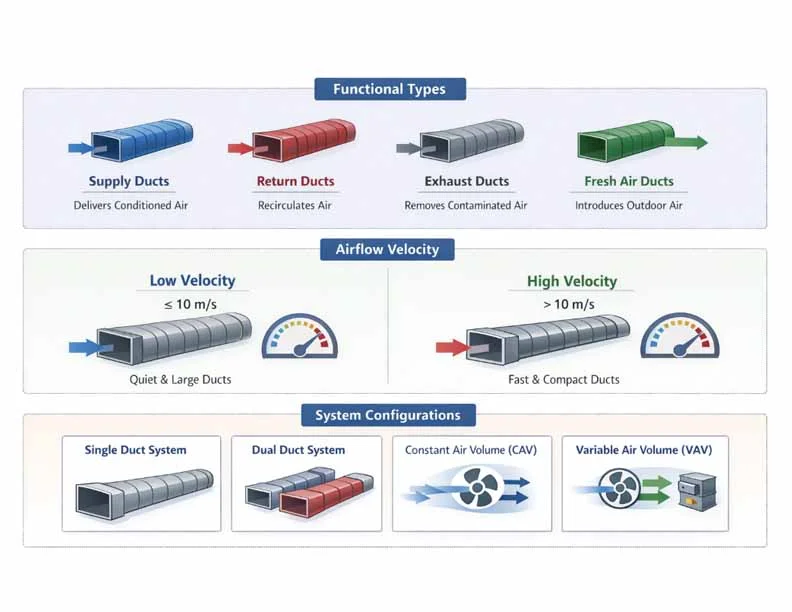
Fig 1: Types of Ducts…
Duct Design Principles
Effective duct design begins with an accurate estimation of airflow requirements based on building heating and cooling loads. These calculations ensure that sufficient air is delivered to maintain desired indoor conditions.
Duct sizing is typically performed using methods such as the equal friction method, which ensures uniform pressure loss, or the static regain method, which is more energy efficient but complex. Pressure losses due to friction and fittings must be carefully evaluated, as they directly influence fan energy consumption. Minimising these losses through optimised layout and sizing is critical for energy-efficient design.
Energy Performance of Duct Systems
Duct systems play a significant role in determining HVAC energy consumption. One of the primary contributors to energy use is fan power, which increases with higher system resistance and follows a cubic relationship with airflow. Leakage in duct systems can result in substantial energy losses, often ranging between 10% and 30%, leading to increased load on HVAC equipment.
Thermal losses or gains in ducts, particularly when located in unconditioned spaces, further degrade system efficiency. Proper insulation is essential to minimise these effects and maintain supply air temperature. Additionally, locating ducts within the conditioned envelope of the building can significantly reduce energy losses.
Energy-Efficient Design Strategies
Several strategies can be employed to improve the energy efficiency of duct systems. Variable Air Volume systems adjust airflow based on demand, reducing fan energy consumption compared to constant air volume systems. Demand-controlled ventilation uses sensors to regulate fresh air intake, minimising unnecessary energy use.
Designing ducts with low pressure drops by reducing bends and optimising layout further enhances efficiency. Air sealing techniques, including the use of mastic sealants and gaskets, are critical for reducing leakage. The integration of smart controls and sensors enables real-time monitoring and optimisation of system performance, contributing to overall energy savings.
Challenges and Common Issues
Duct systems often face several challenges that can compromise their performance. Improper sizing can lead to inadequate airflow or excessive pressure losses, while high leakage rates result in significant energy waste.
Poor insulation can cause unwanted heat transfer, reducing system efficiency. Noise issues may arise from high velocities or poor design, and uneven air distribution can lead to occupant discomfort. Addressing these issues requires careful design, installation, and maintenance practices.
Best Practices for Sustainable Duct Design
To ensure optimal performance, duct systems should be designed with energy efficiency as a priority. This includes minimising duct length, avoiding sharp bends, and optimising airflow velocities to balance efficiency and noise. Proper insulation and airtight sealing are essential to reduce thermal and leakage losses. Locating ducts within conditioned spaces further enhances performance. Regular inspection and maintenance are also necessary to sustain system efficiency over time.
Conclusion
Duct systems are integral to the performance and efficiency of HVAC systems, influencing energy consumption, indoor air quality, and occupant comfort. From an energy perspective, optimising duct design can lead to significant reductions in HVAC energy use, typically ranging from 20% to 30%.
By incorporating efficient design principles, advanced control strategies, and proper construction practices, duct systems can contribute to the development of sustainable and high-performance buildings.