








Executive Summary
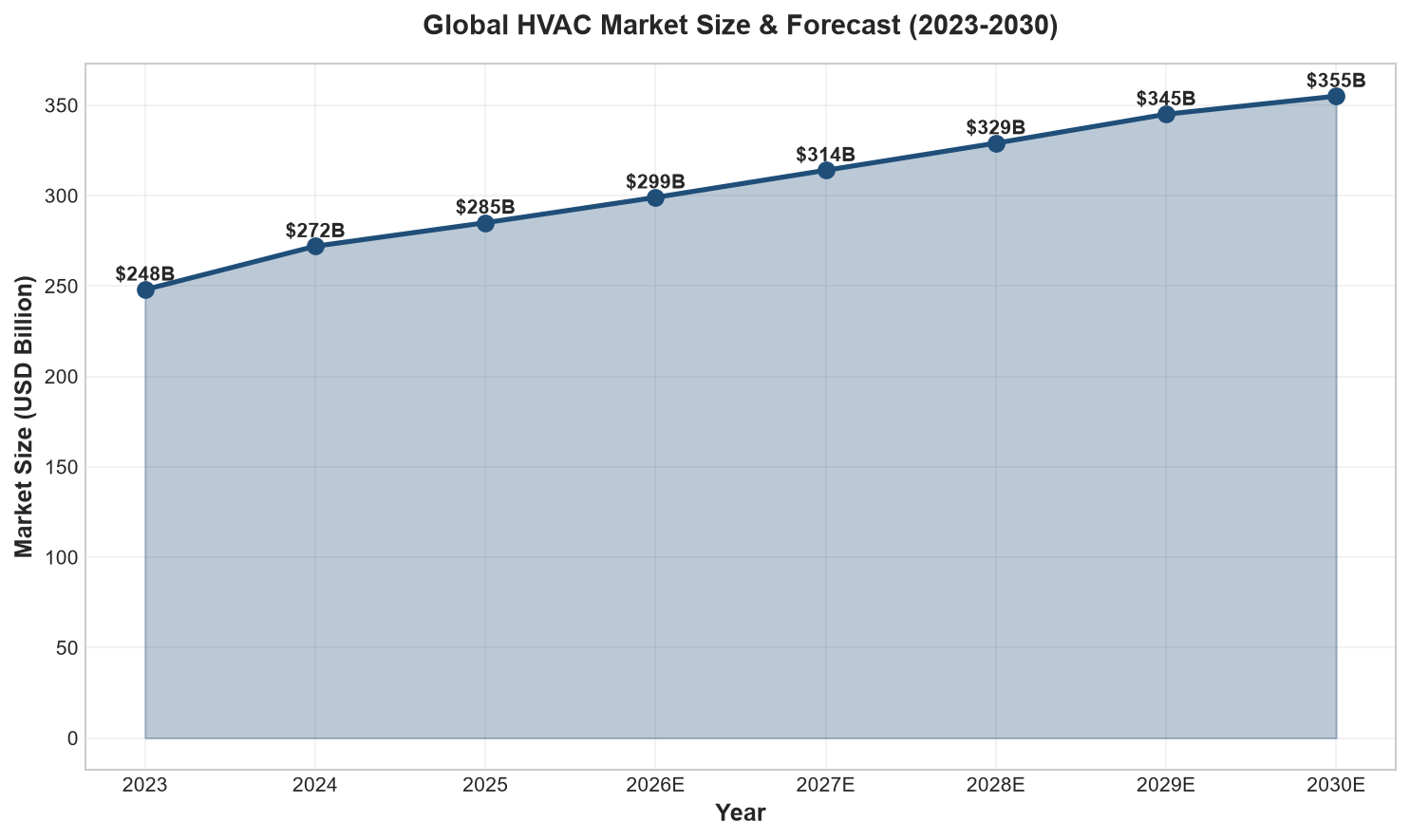
The global HVAC market reached approximately USD 299 billion in 2026, growing 4.9% year-on-year. This week’s intelligence report covers four key product categories, the latest brand technology breakthroughs, regulatory developments, and regional sales trends shaping the industry through August 2026.
Key highlights include: the continued surge of Chinese air conditioner exports to Europe amid record-breaking heatwaves; Mitsubishi Electric’s launch of the City Multi R32 YXM VRF range with 20% running cost reduction; the U.S. EPA’s revised Technology Transitions Rule easing compliance deadlines; and data center cooling maintaining its position as the fastest-growing HVAC segment at 15.6% annual growth, now reaching USD 21.8 billion in global spending.
1. Fan Coil Unit (FCU) Market Update
The global FCU market was valued at USD 10.29 billion in 2026 and is projected to grow to USD 14.49 billion by 2034 (CAGR 4.37%). The compact fan coil segment continues to grow faster at 7.12% CAGR. Asia Pacific dominated with 43.36% market share, driven by rapid urbanization and commercial construction across China, India, and Southeast Asia.
Key Developments
- Daikin Industries: Acquired Climaveneta’s European HVAC business, expanding FCU and chiller portfolio. Launched CO2-based VRF systems for the European market in response to F-gas phase-down regulations.
- LG Electronics: Partnered with ABB to integrate FCU systems with building automation platforms, enabling BACnet/IP and KNX open protocol connectivity for smart building applications.
- Carrier Global: Launched a new high-efficiency commercial FCU line with variable-speed EC motors, reducing energy consumption by up to 40% compared to traditional AC motor units.
- Samsung Electronics: Showcased FläktGroup FCU products at MCE 2026, strengthening data center cooling capabilities with integrated AHU and chilled beam solutions.
- Mitsubishi Electric: Updated CITY MULTI VRF catalog for 2025-2026 with enhanced R-454B compatible models featuring advanced inverter technology and SEER ratings pushing efficiency boundaries.
Market Data & Trends
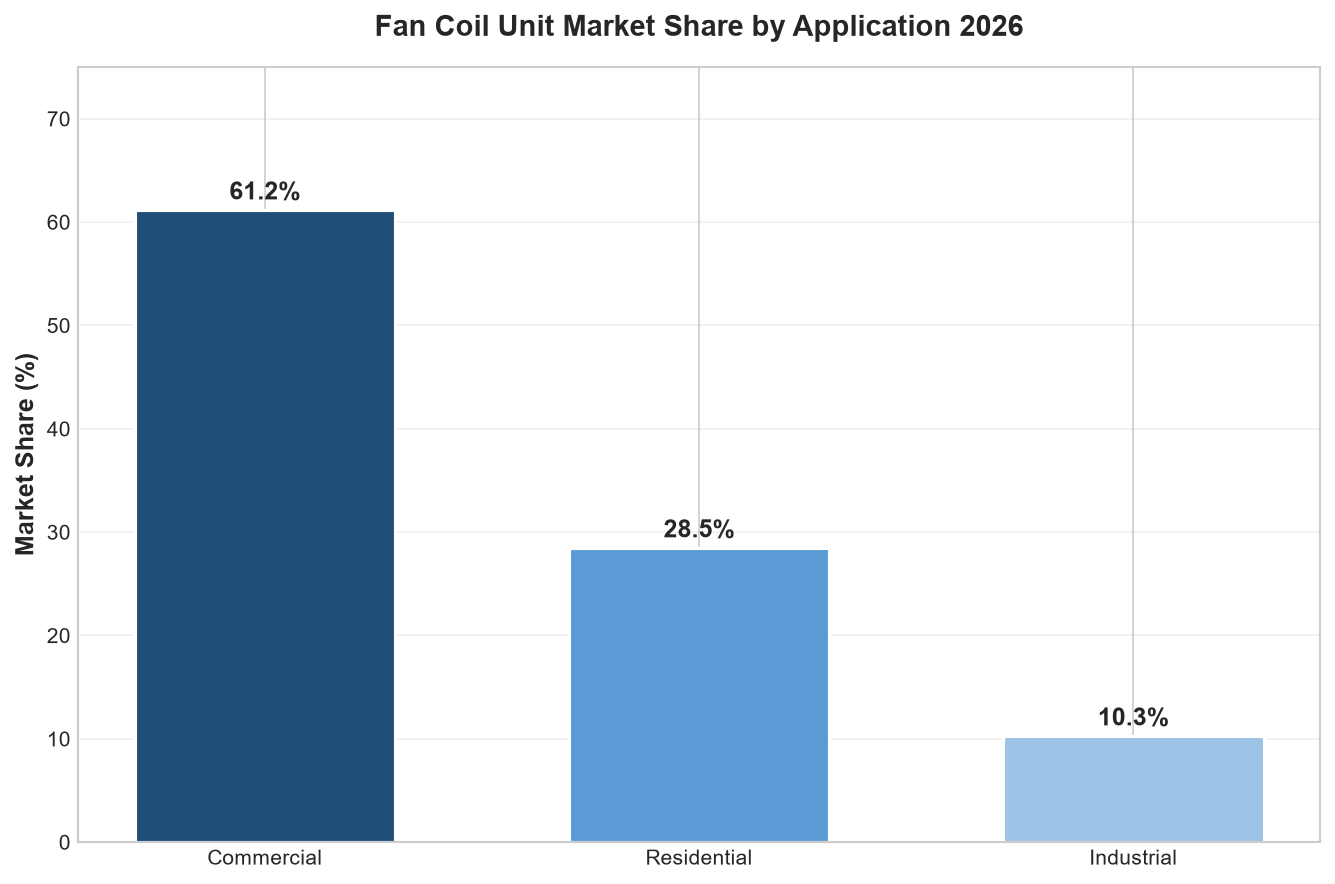
Commercial applications held the dominant share of 61.24% in 2026, driven by increasing investments in office buildings, hotels, healthcare facilities, and retail developments. Hotels remained the largest end-user segment at 29.63%, followed by hospitals and office buildings. The transition from AC to EC motors is emerging as a key technological shift, significantly influencing product mix and average selling prices.
2. Mini Chiller Market Update
The worldwide compact chiller market was valued at USD 1.54 billion in 2026, projected to reach USD 2.11 billion by 2032 (CAGR 5.12%). The broader modular chiller market stood at USD 4.8 billion in 2026, forecast to reach USD 7.2 billion by 2034. Air-cooled mini chillers dominated by cooling method, generating USD 949.32 million in revenue.
Product Innovations
- Pfannenberg: Introduced next-generation VLV 4-12 and DMC 8.0 chillers for BESS thermal management, alongside the EB 2.0 ECO Chiller utilizing compressor inverter technology to reduce power consumption by up to 65%.
- Laird Thermal Systems: Launched EFC recirculating chiller with natural refrigerant R290 (near-zero GWP), targeting laboratory and analytical applications requiring precise temperature control.
- Boyard: Developed mini chiller with triple-cooling flexibility (Direct Expansion, Liquid, Air) and R290 low-GWP refrigerant, achieving 50% cooling capacity improvement in medical diagnostic applications.
- Peter Huber: Expanded Minichiller line with more powerful models (800, 1000, 1200) while preserving compact layout, positioning natural refrigerants as part of a broader sustainability narrative.
- Daikin Industries: Offers R-32 Small Inverter Chiller range with full inverter technology, wide operating range, and focus on energy efficiency for small commercial and process cooling applications.
Market Dynamics
Chinese manufacturers led by Midea Group and Gree continue aggressive market share expansion, with pricing 12-18% below Western equivalents. The industrial and laser processing end-use segment generated the most revenue at USD 564.58 million in 2025. Battery energy storage systems (BESS) have moved from niche need to direct product target for compact chillers, reshaping R&D priorities.
3. Heat Pump Water Heater (HPWH) Market Update
The total HPWH market was valued at USD 14.3 billion in 2026, forecast to reach USD 22.76 billion by 2031 (CAGR 11.92%). Global installations surpassed 140 million units, up 12.6% YoY. Europe leads with 38% market share, driven by REPowerEU plan and aggressive decarbonization policies.
Key Highlights
- A. O. Smith: Unveiled Signature 900 Smart Hybrid HPWH with smart home connectivity and predictive maintenance capabilities, targeting the premium residential segment.
- Johnson Controls: Acquired Hybrid Energy AS for high-temperature industrial heat pump solutions, expanding into commercial and district heating applications.
- Midea (MBT): Showcased R290 heat pump portfolio covering 4kW to 70kW at MCE 2026. The Mars Large R290 ATW Commercial Heat Pump delivers up to 85°C leaving water temperature with A+++ energy rating.
- Samsung Electronics: EHS Heat Pump System achieves COP up to 8.2 with heat recovery technology, redirecting waste heat from cooling to domestic hot water production.
- Mitsubishi Electric: Launched ecodan Pro CAHV using low-GWP refrigerant R454C to deliver space heating and industrial hot water up to 74°C, suitable for multi-family residences and hospitals.

Policy Support
47 countries now offer direct subsidies or tax credits for HPWH installation. The U.S. Section 25C tax credit covers 30% of HPWH costs up to USD 2,000 through 2032, though the ‘Big Beautiful Bill’ (July 2025) repeals residential tax credits after December 31, 2025. China’s updated standard (GB 29541-2025) raised Tier 1 efficiency threshold to COP 5.0. In Europe, the EPBD 2025 requires phase-out of pure electric water heaters by 2027, creating massive replacement demand.
4. Air-Cooled Scroll Chiller Market Update
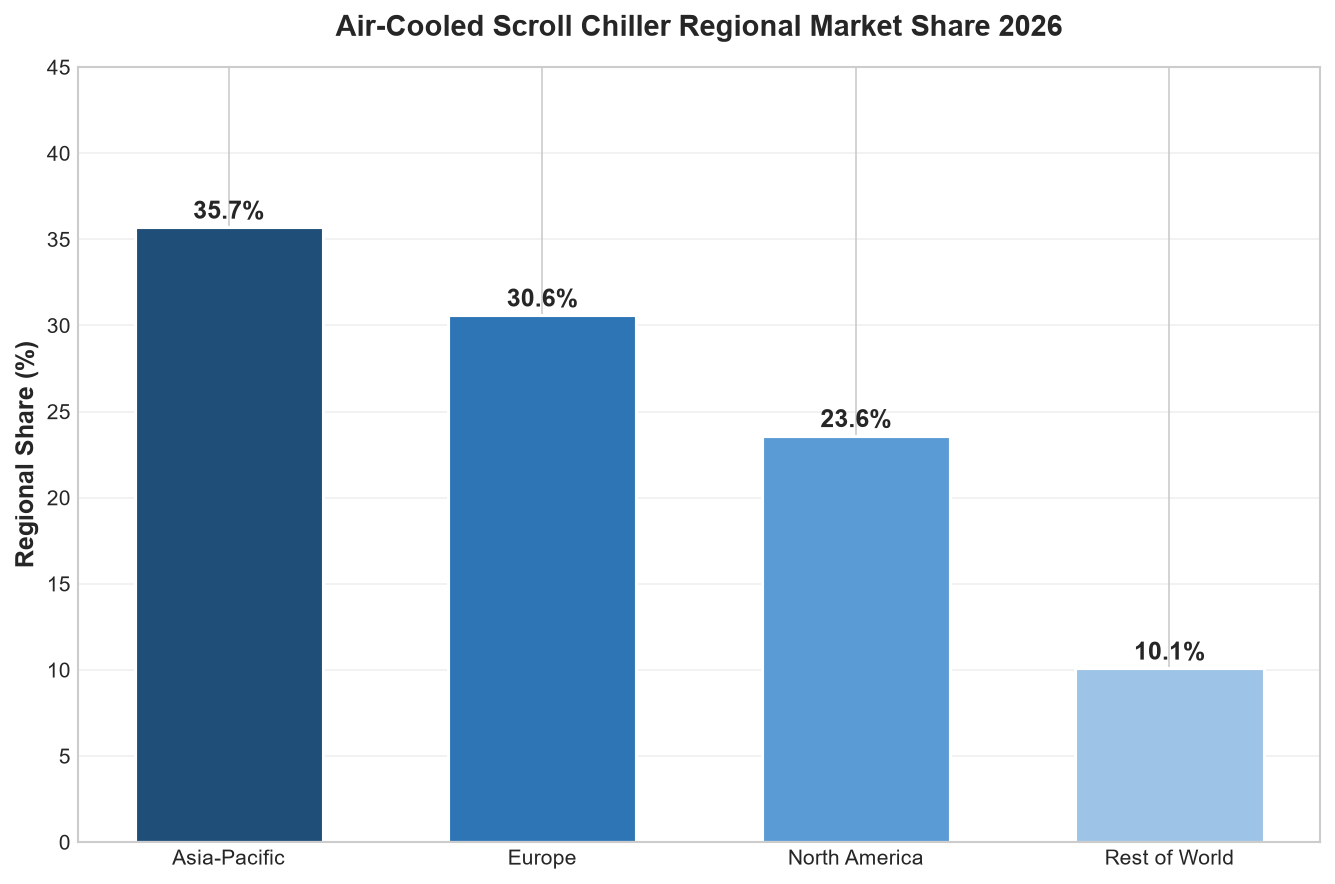
The global air-cooled scroll chiller market generated approximately USD 520 million in 2026. Asia Pacific led with 35.7% share, followed by Europe (30.6%) and North America (23.6%). The shift toward R-32 and R-454B is accelerating, though R-454B supply shortages persist in North America.
Regulatory Impact
- EPA Technology Transitions Rule restricts high-GWP HFC refrigerants (GWP >= 700) in new chillers from January 1, 2026. The May 2026 revision eased installation deadlines for pre-2025 R-410A equipment.
- R-410A prices reached $35-50/lb in 2025, projected to hit $70-90/lb by 2029, driving total cost of ownership calculations toward lower-GWP alternatives.
- Section 232 tariffs on steel (25-50%) restructured April 2026, increasing costs for metals-intensive chiller products.
- EU F-Gas Regulation mandates continued phasedown of HFC quotas, with natural refrigerant penetration reaching 34% in 2026 (up from 28% in 2025).
- China banned HFC refrigerants in refrigerators/freezers from January 2026; R-410A residential AC ban scheduled from 2029.
Technology Trends
Fixed-speed units still dominate with ~60% market share, while inverter-driven systems gain ground for part-load efficiency. Midea’s AirBoost Vera Air-Cooled Magnetic Bearing Centrifugal Chiller features dual-power switching and delivers outlet water up to 36°C with 20°C temperature difference. Standard indirect natural cooling and eco-friendly refrigerant compatibility make it a sustainable choice for modern data centers.
5. Policy & Regulatory Developments Impacting AC Sales
United States
- EPA TT Rule Revision (May 2026): Removed January 1, 2026 installation deadline for pre-2025 R-410A equipment. Expected to save $976M through 2050. Most manufacturers choose to prioritize clearing R-410A inventory over R-454B transition.
- HFC Phasedown: R-410A production cut to 60% of baseline in 2026. AIM Act targets 85% reduction by 2036. Long-term trajectory unchanged despite short-term easing.
- Tax Credit Changes: The ‘Big Beautiful Bill’ repeals Section 25C/25D residential tax credits after December 31, 2025; commercial 45L/179D after June 30, 2026. Creates uncertainty in residential replacement market.
- R-454B Supply Crisis: Widespread shortages throughout 2025 persist into 2026. Some technicians attempting unsafe refrigerant mixing practices, prompting EPA enforcement warnings.
European Union
Europe’s air conditioning market surged nearly 60% year-on-year in the first five months of 2026, with portable air conditioners surging over 200%. Chinese manufacturers captured massive market share as European demand outpaced local supply. However, regulatory complexity creates a ‘trilemma’: rising temperatures drive demand, historic building preservation rules limit installation, and carbon neutrality targets discourage energy-intensive cooling.
- Natural refrigerant penetration reaching 34% in 2026 (up from 28% in 2025).
- EPBD 2025 requires phase-out of pure electric water heaters by 2027.
- Heat pump installations up 38% vs 2022; Nordic countries exceed 60% penetration in new homes.
- From January 2027, stricter GWP limits for units <=12kW will require R290 transition, raising manufacturing costs 10-20%.
- China’s H1 2026 AC exports to EU reached $3.76 billion (+43.2% YoY), with mobile AC exports up 70%.
China & Asia-Pacific
- China banned HFC refrigerants in refrigerators/freezers from January 2026; R-410A residential AC ban from 2029.
- GB 21455-2025 raised Tier 1 energy efficiency threshold by 12%, accelerating inverter adoption.
- ASEAN countries implemented MEPS >= 3.2, pushing low-efficiency products out of market.
- China’s HVAC exports reached USD 54.7 billion in 2025 (+9.3% YoY), cementing position as global manufacturing hub.
- India’s RAC market declined 21.7% due to unseasonal rains, but strong rebound expected in H2 2026 supported by deferred purchasing.
6. HVAC Brand Technology Breakthroughs
Samsung Electronics
- Bespoke AI WindFree Pro: 7 customized airflow patterns, AI presence tracking with radar sensors, 30% energy savings via SmartThings.
- DVM S2+ VRF: Low-GWP R-32 refrigerant, onboard AI chip enabling leak detection and adaptive defrost without cloud connectivity, heating to -30°C.
- Hylex Universal Heat Pump: Non-proprietary inverter heat pump compatible with most 24VAC coils, using R-454B refrigerant.
- SmartThings Pro: Centralized multi-site management platform for enterprises, offering real-time monitoring and AI-driven energy insights.
Daikin Industries
- VRV5 Evolution: AI thermal load prediction, up to 25% energy savings. Lowest-GWP commercial VRF system available.
- CO2-based VRF: Launched for European market directly responding to F-gas phase-down requirements.
- FTXM-A Series: SEER 8.9, SCOP 5.3, 4th-generation AI inverter with cloud diagnostics.
- VKM-VM IAQ Solution: Decentralized fresh air unit with heat recovery and humidity control (June 2026).
Mitsubishi Electric
- City Multi R32 YXM: New range with patented vertical flat tube heat exchanger, 20% reduction in running costs, 10% improvement in energy efficiency, 30-year leak detector lifespan.
- ecodan Pro CAHV: Modular air-source heat pump using R454C, delivering heating and hot water up to 74°C for commercial applications.
- ecodan Pro e-Series Chiller/Heat Pump: Modular cooling and heating for commercial buildings with scalable capacity and redundancy.
- X-Generation VRF: Capable of heating/cooling up to 50 zones, capacities from 6 to 32 tons.
LG Electronics
- Multi V i VRF: Predictive algorithms for cooling optimization, AI-powered performance management.
- Modular Inverter Scroll Heat Pump Chiller: Each unit requires only single power and piping connection, supporting up to 6 connected units with touchscreen HMI.
- Direct-to-Chip Cold Plate Cooling: For data center high-density thermal management, targeting AI server cooling requirements.
- ACP i: Advanced building control platform providing centralized monitoring and data-based recommendations.
Chinese Brands
- Haier: 4Hz ultra-low frequency AC, minimum 124W power, -37°C to 67°C operating range. Open-Control AI system achieves 15% energy savings with 0-debug plug-and-play deployment.
- Gree: GMV9 with AI energy-saving chip, SEER 9.0, 25%+ energy savings, -35°C to 60°C range. European retail sales jumped 50% in H1 2026.
- Midea: V9 VRF with ShieldBox II technology (70% volume reduction), Breezeless 2026 with HEPA filtration, Flash Cool 2.0. Western Europe AC sales climbed 70% in H1 2026.
- Hisense: Air Master (U8) series all rated A+++ in EU energy efficiency. Launched customized split-system products tailored for European market requirements.
7. Global Market Sales Data & Customer Purchasing Trends
Market Data Summary
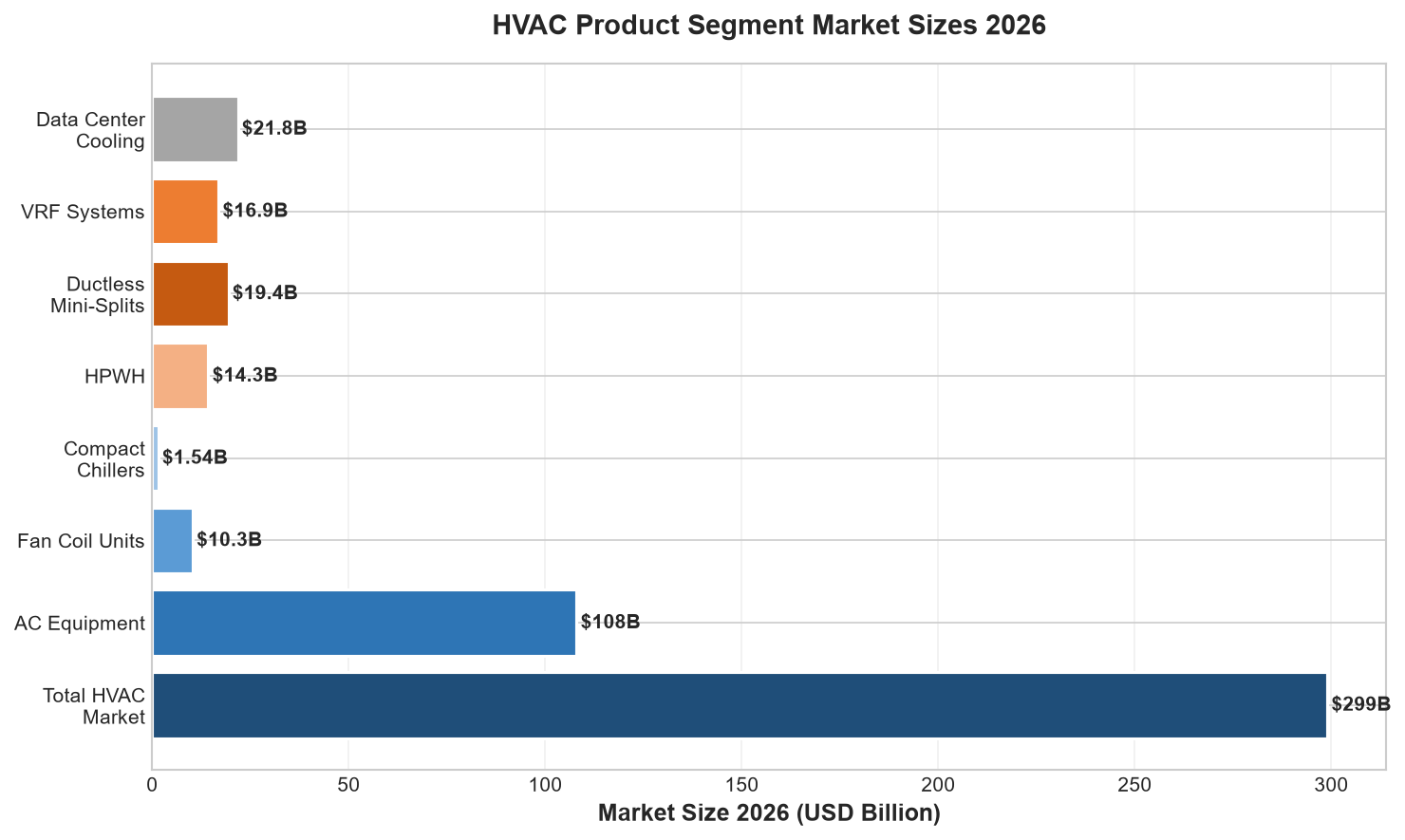
| Market Segment | 2026 Size | Forecast | CAGR |
|---|---|---|---|
| Total HVAC Market | $299B | $355B (2030) | 4.9% |
| Global AC Equipment | $108B | $159B (2031) | 8.0% |
| Fan Coil Units | $10.3B | $14.5B (2034) | 4.4% |
| Compact Chillers | $1.54B | $2.11B (2032) | 5.1% |
| HPWH Market | $14.3B | $22.8B (2031) | 11.9% |
| Ductless Mini-Splits | $19.4B | $31.3B (2032) | 8.3% |
| VRF Systems | $16.9B | $34.5B (2031) | 12.5% |
| Data Center Cooling | $21.8B | $38.0B (2030) | 15.6% |
Customer Purchasing Trends
- Retrofit/replacement = 62.78% of HVAC market; U.S. replacements up 14% in 2024.
- Inverter technology: 72.3% of residential AC market share globally.
- Smart/connected AC share jumped from 12% to 21% in Southeast Asia (2024-2025).
- Online channels: 31% of SE Asia retail sales, 48%+ in China.
- Data center cooling: Johnson Controls reports 18% of commercial HVAC revenue from data centers (up from 12%).
- European consumers prioritize portable and easy-install solutions due to historic building constraints and high installation costs (€1,000-2,000 per unit).
- R290 natural refrigerant products gaining preference in EU due to F-Gas compliance and long-term carbon cost considerations.
8. Regional Market Insights
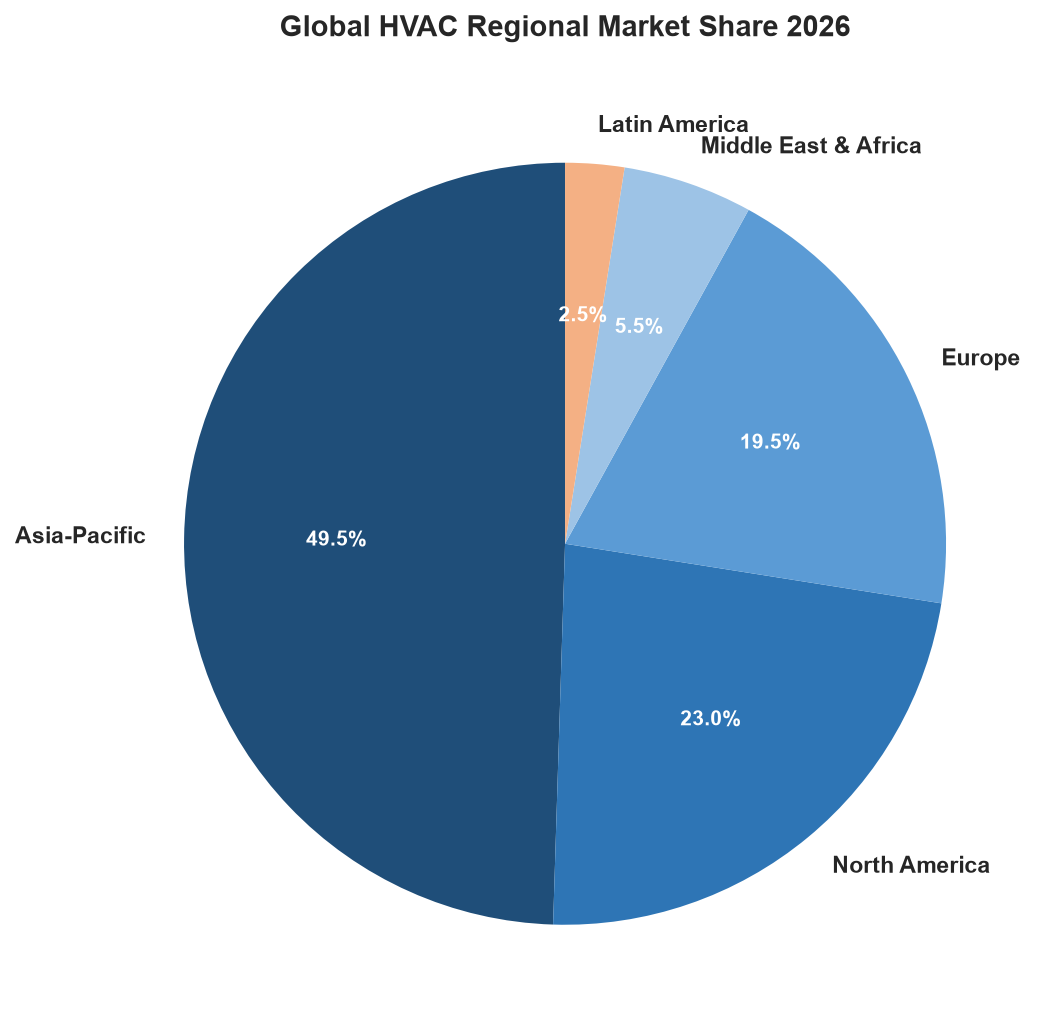
Asia-Pacific (49.5% of global market)
China contributed 42% of regional value, with 6.73% growth. RAC market rose 1.9% to 68.4M units; PAC fell 6.7%. China’s HVAC exports reached USD 54.7B (+9.3% YoY). Southeast Asia market reached USD 18.5B (+12.7% growth), with smart AC share doubling to 21%. Regional manufacturing capacity = 19% of global AC production.
North America
Market showing mixed signals in 2026. While commercial construction supports steady chiller demand, residential unitary AC faced double-digit decline due to weak real estate, policy uncertainty, and cooler summer in some regions. R-410A inventory clearance prioritized over A2L adoption due to EPA rule easing. Data center cooling remains bright spot with 15.6% growth.
Europe
Slight overall decline in traditional RAC (-1.2%) and PAC (-2.3%), but heat pump installations surged 38% vs 2022. Nordic countries exceed 60% heat pump penetration in new homes. Record heatwaves drove AC sales up 60% YoY. Chinese brands gained significant market share: Midea Western Europe sales +70%, Gree France +50%, Haier premium series gaining traction.
Middle East & Africa
RAC market valued at USD 6.5B in 2025, expected to reach USD 7.39B in 2026. Projected USD 11.9B by 2035 (CAGR 5.10%). Strong expansion partially offset global slowdown, driven by mega infrastructure projects and increasing urbanization in GCC countries.
India
RAC market experienced 21.7% decline due to unseasonal rains and early monsoon. Expected strong rebound in H2 2026 supported by deferred purchasing and government PLI scheme incentives for domestic manufacturing. Underpenetrated modular chiller deployment in emerging IT corridors offers first-mover positioning opportunities.
9. Conclusion & Market Outlook
The global HVAC industry in 2026 stands at the intersection of regulatory transformation, technological innovation, and shifting market dynamics. Several key themes define the current landscape:
- Refrigerant Transition: Accelerating globally at uneven rates. The U.S. revised timelines create breathing space while Europe and China push forward with R290 and natural refrigerant adoption.
- AI & Smart Technology: Moving from marketing features to core value propositions. HVAC equipment is becoming edge computing nodes with onboard AI chips enabling real-time optimization.
- Data Center Cooling: Represents the highest-growth opportunity at 15.6% annual growth, driving liquid cooling adoption and direct-to-chip solutions from LG, Daikin, and Midea.
- Chinese Manufacturers: Expanding global share from 28% to 39% (2020-2025) in emerging markets. European heatwave created unexpected breakthrough opportunity with +43% export growth.
- Market Outlook: Global HVAC market projected to reach USD 355B by 2030, with data centers, healthcare, and emerging markets driving highest growth. HPWH segment leads at 11.9% CAGR.
Sources: EPA, DOE, JARN, Research and Markets, Industry Reports, Manufacturer Announcements | Prepared by DERK HVAC | www.derkhvac.com