








When selecting fan coil units for a commercial building, a relatively small difference in motor power consumption can become significant over years of operation.
Consider a hotel with 200 guest rooms. If each fan coil runs for several thousand hours annually, saving even 30 or 40 watts per unit could make a measurable difference to the electricity bill.
But that does not mean DC fan coil units are always the better choice. A small office operating eight hours a day has a different cost profile from a hotel running around the clock.
The question is not simply which motor consumes less electricity. It is whether the expected savings justify the additional investment over the equipment’s working life.
AC and DC Fan Coil Units: What Actually Changes?
AC fan coil units typically use conventional motors with several preset fan speeds. Their control systems are relatively straightforward, and they remain a practical option for many commercial buildings.
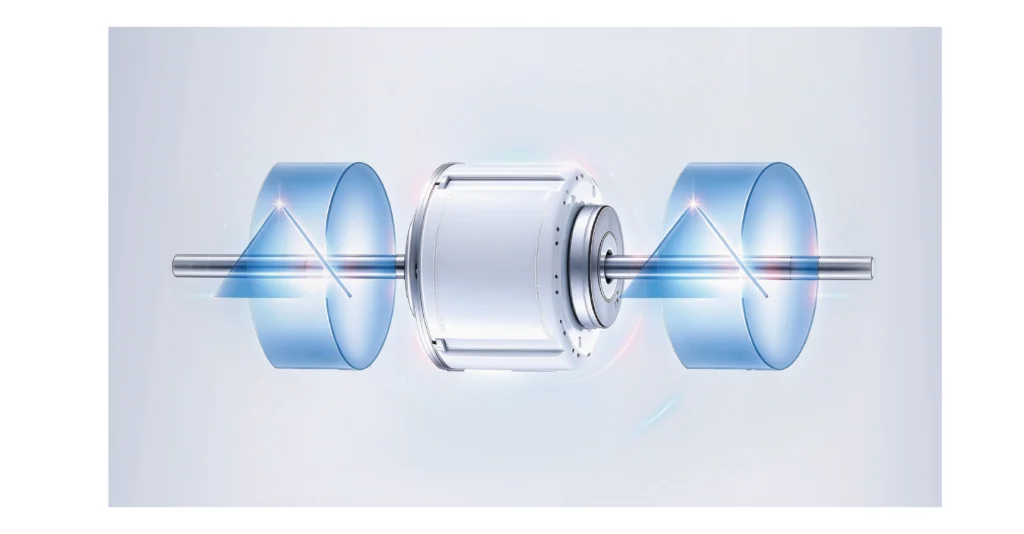
DC fan coil units use electronically controlled brushless motors. These allow more flexible speed regulation and can reduce electrical power consumption, particularly when operating at lower airflow settings.
In practical terms, the difference becomes more relevant when a building does not require full airflow throughout the day.
A hotel guest room, for example, may need higher airflow when initially cooling the space, followed by lower airflow once the room reaches its set temperature.
A suitable DC motor and controller can adjust operation more closely to that changing demand.
However, the motor is only one part of the fan coil. Airflow, cooling capacity, noise levels, and system controls still need to be considered together.
Where DC Motors Make Financial Sense
Hotels and Serviced Apartments
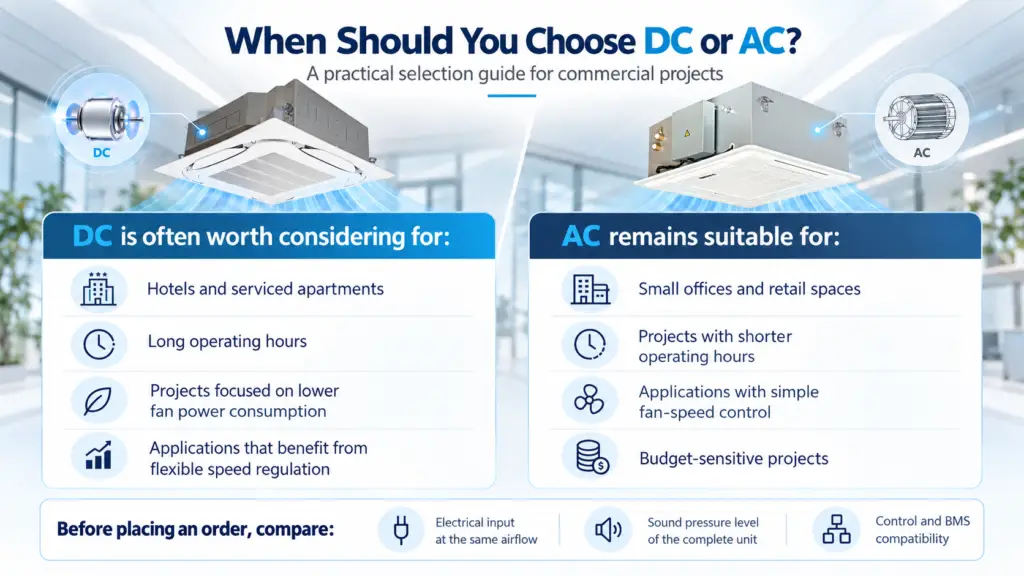
Hotels often have extended operating hours, making fan electricity consumption an important consideration.
Even when rooms are unoccupied, some properties operate their fan coils according to predefined temperature or ventilation strategies.
For these buildings, the benefit of DC motors depends on how often the fans operate and at what speed.
Noise is another consideration, particularly at night. DC motors can offer more flexible low-speed operation, but they do not automatically make an entire fan coil quieter.
The published sound levels of the complete units should always be compared.
Office Buildings
Office projects require a different calculation.
A building operating five days per week, with fan coils switched off outside business hours, may take longer to recover the additional cost of DC motors.
However, offices with varying occupancy levels and more sophisticated control systems may benefit from flexible fan speed regulation.
The decision should be based on expected operating hours and the actual power consumption of the proposed models.
Smaller Commercial Buildings
For small offices, retail spaces, or projects where initial equipment cost is particularly important, AC fan coils can still be a reasonable choice.
Where conventional speed control is sufficient, there may be little benefit in paying for additional control capabilities.
Selecting AC technology is not necessarily a compromise. It may simply be the appropriate specification for the project.
What Should You Compare Before Choosing?
Motor type should not be the only factor in an FCU specification.
Three figures deserve particular attention:
Electrical power input: Compare units delivering the same airflow under equivalent operating conditions. For ducted units, external static pressure must also be considered.
Sound pressure level: Check the acoustic performance of the complete fan coil, not just the motor. Installation and operating speed can significantly influence noise.
Control compatibility: Confirm whether the selected unit works with the project’s thermostats and building management system. A DC motor does not automatically guarantee Modbus or BMS connectivity.
These details become especially important when replacing existing AC units with DC alternatives.
A Comparison Using DERK’s Published Product Data
Rather than making a general claim about energy savings, it is more useful to examine the specifications of actual products.
DERK’s 2026 catalogue lists the following figures for two 600 CFM, two-pipe, C-Series four-way cassette fan coil units.
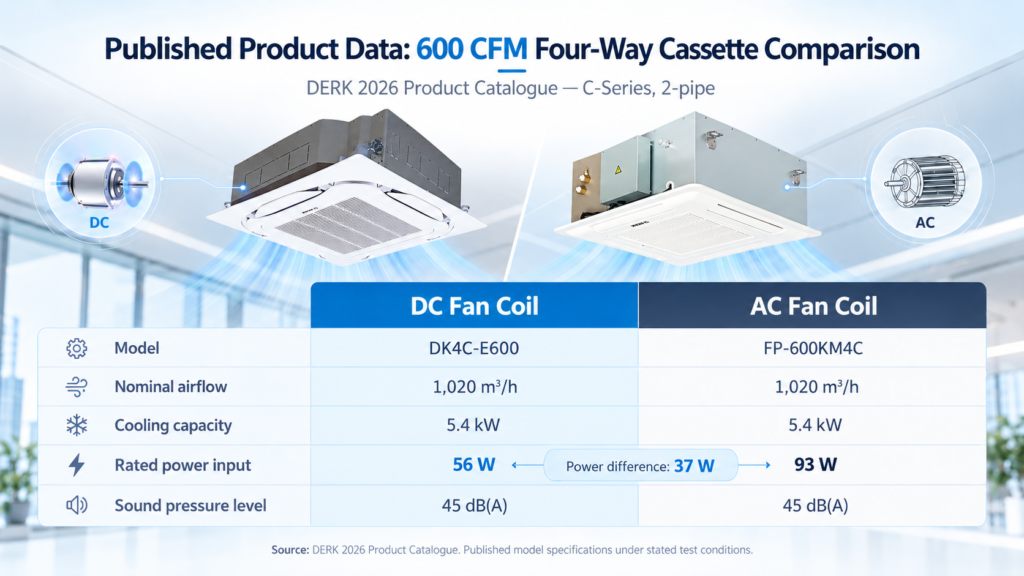
Source: DERK 2026 Product Catalogue, Four-Way Cassette C Series, D19/D20. Values are published model specifications under the catalogue’s stated test conditions.
Both models provide the same nominal airflow and cooling capacity, while the DC version has a lower published electrical input.
Interestingly, both models also have the same listed sound pressure level of 45 dB(A).
This illustrates why it is important to evaluate electrical performance and acoustic performance separately rather than assuming that a DC motor will always produce a quieter unit.
What Could the Power Difference Mean Over a Year?
The difference between these two published power inputs is 37 watts.
For illustration, assume a project has 200 fan coil units operating for 3,000 hours annually, with an electricity price of US$0.15 per kWh.
The calculated annual electricity difference would be:
37 W × 200 units × 3,000 hours ÷ 1,000 = 22,200 kWh
At US$0.15 per kWh, that equals approximately:
US$3,330 per year.
This is an illustrative calculation based on the published rated power inputs, not a measured saving from an actual installation. It assumes the stated power difference is maintained throughout the operating hours. Real-world savings will depend on fan speeds, controls, and the building’s operating schedule.
The remaining question is the price difference between the two models.
If the additional investment in DC fan coils can be recovered within an acceptable period through reduced electricity consumption, the DC option may be financially justified.
If operating hours are limited or the price difference is substantial, AC may offer better overall value.
There is no universal answer. The numbers need to reflect the project.
DERK offers AC and DC fan coil options across different product configurations. For projects requiring a comparison, our team can provide model specifications, available control options, and technical information to support equipment selection.
Planning an HVAC project?
Share your required airflow, estimated operating hours, and control requirements with DERK. We can help you compare suitable AC and DC fan coil configurations.