








Meta Description: Choosing between a mini chiller and VRF for your villa or small hotel? We break down the real total cost of ownership — equipment, installation, energy, maintenance — with actual case studies.
Introduction
If you’re building or renovating a villa, boutique hotel, or small commercial property, you’ve probably hit the same wall every owner does: which HVAC system actually saves you money — not just on day one, but over the next 15 years?
Variable Refrigerant Flow (VRF) systems have dominated the premium segment for years, marketed as the gold standard for multi-zone comfort. But a quieter revolution is happening: full DC inverter mini chillers — once considered only for large buildings — have scaled down to sizes perfect for villas and small hotels, and they’re challenging VRF on the one metric that matters most: total cost of ownership (TCO).
In this article, we compare both systems across every cost dimension, walk through two real-world case studies, and help you decide which one belongs in your project.
First: What Are We Actually Comparing?
VRF (Variable Refrigerant Flow)
- One outdoor condensing unit connected to multiple indoor fan coil units via refrigerant piping
- Excellent part-load efficiency, individual zone control
- Higher equipment cost, specialized installation, refrigerant leak concerns
Mini Chiller (Air-Cooled, Full DC Inverter)
- One compact outdoor unit produces chilled/hot water, circulated to indoor fan coils or underfloor heating
- Water-based distribution = safer, simpler piping, easier maintenance
- Integrated hydraulic module means faster installation, fewer external components
The Total Cost of Ownership Framework
Too many owners only compare the quote in front of them. The real number includes five layers:
1. Equipment cost — the units themselves
2. Installation cost — piping, labor, commissioning, auxiliary components
3. Energy cost — monthly electricity over the system’s lifetime
4. Maintenance cost — annual service, filter changes, refrigerant top-ups, repairs
5. Replacement/lifecycle cost — how long the system lasts before major overhaul
Let’s put real numbers to each.
Case Study 1: A 480 m² Luxury Villa in Hangzhou, China
Project profile: 6 bedrooms, home theater, gym, open-plan living. Owner wanted year-round cooling + heating + underfloor heating capability. 8 climate zones.
| Cost Dimension | VRF System (8 zones, 28kW) | DERK Mini Chiller (DMC-V28SN1T, 28kW) |
| Equipment | $22,500 | $16,800 |
| Installation (piping, labor, commissioning) | $9,200 | $6,500 |
| Auxiliary components (pumps, tanks, valves) | Included in VRF outdoor unit | $0 (integrated hydraulic module) |
| Total initial investment | $31,700 | $23,300 |
| Annual energy (cooling + heating, 8 months/yr) | $3,680 | $2,940 |
| Annual maintenance | $780 | $480 |
| 15-year energy + maintenance | $66,900 | $51,300 |
| 15-Year Total Cost of Ownership | $98,600 | $74,600 |
| TCO Savings with DERK Mini Chiller | — | $24,000 (24% less) |
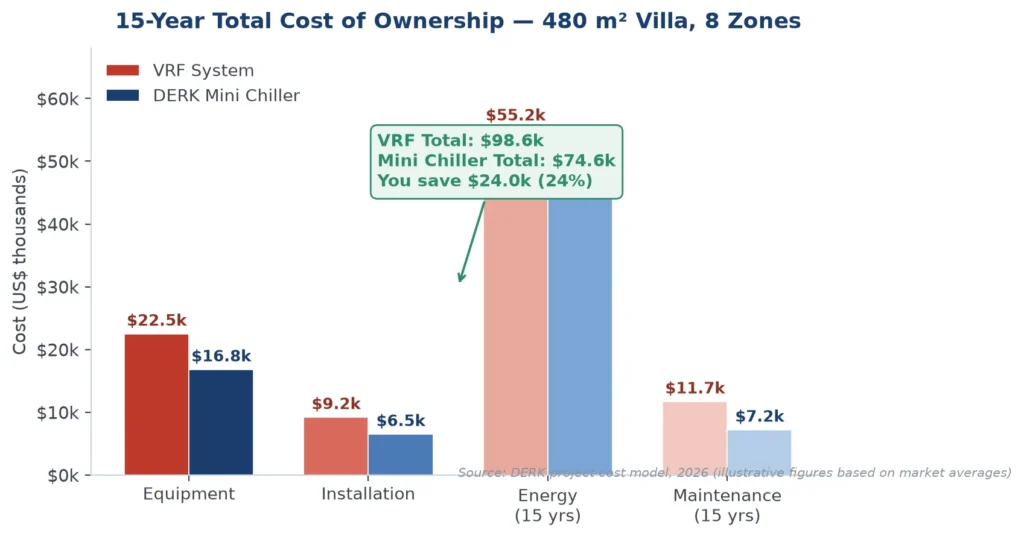
Figure 1. 15-year total cost of ownership breakdown — 480 m² villa project.
The difference: $24,000 over 15 years — enough to fund a full kitchen renovation.
Why the gap? Three reasons specific to this project:
Integrated hydraulic module saved $2,700 on installation. The DERK mini chiller comes factory-equipped with a variable-speed water pump, expansion tank, safety valve, automatic refill valve, flow switch, and Y-type filter. No separate mechanical room, no sourcing components from multiple suppliers.
Water piping is 30–40% cheaper than refrigerant piping. VRF requires insulated copper refrigerant lines with precise brazing and vacuum charging — specialized labor. Mini chillers use standard water piping that any HVAC technician can install.
DC inverter + weather curve control cut energy by 20%. The DERK unit’s intelligent weather curve automatically adjusts water temperature, compressor capacity, and pump speed based on outdoor conditions, reducing energy consumption by 7–18% compared to fixed-output systems.
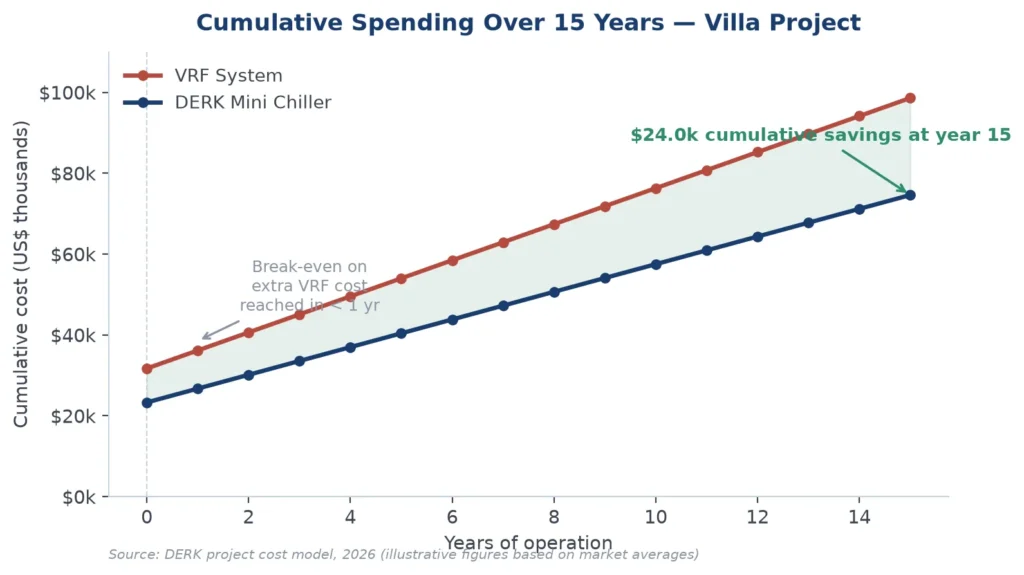
Figure 2. Cumulative spending over 15 years — the mini chiller pays back its lower upfront cost from day one, and the savings gap widens every year.
Owner feedback (6 months post-installation): “We were quoted VRF by three contractors and almost went with it. The mini chiller not only cost less upfront — our winter heating bill is 22% lower than our previous home’s VRF system, and the underfloor heating is a game-changer.”
Case Study 2: A 24-Room Boutique Hotel in Chiang Mai, Thailand
Project profile: 24 guest rooms, lobby, restaurant, spa. Tropical climate (year-round cooling, occasional heating in December–January). High occupancy variability — 40% in low season, 95% in peak season.
| Cost Dimension | VRF System (3 outdoor units, 84kW) | DERK Mini Chiller (3× DMC-V28SN1T, 84kW) |
| Equipment | $58,000 | $44,200 |
| Installation | $21,500 | $14,800 |
| Total initial investment | $79,500 | $59,000 |
| Annual energy (12 months cooling) | $14,200 | $11,100 |
| Annual maintenance | $2,800 | $1,650 |
| 15-year energy + maintenance | $255,000 | $191,250 |
| 15-Year Total Cost of Ownership | $334,500 | $250,250 |
| TCO Savings with DERK Mini Chiller | — | $84,250 (25% less) |
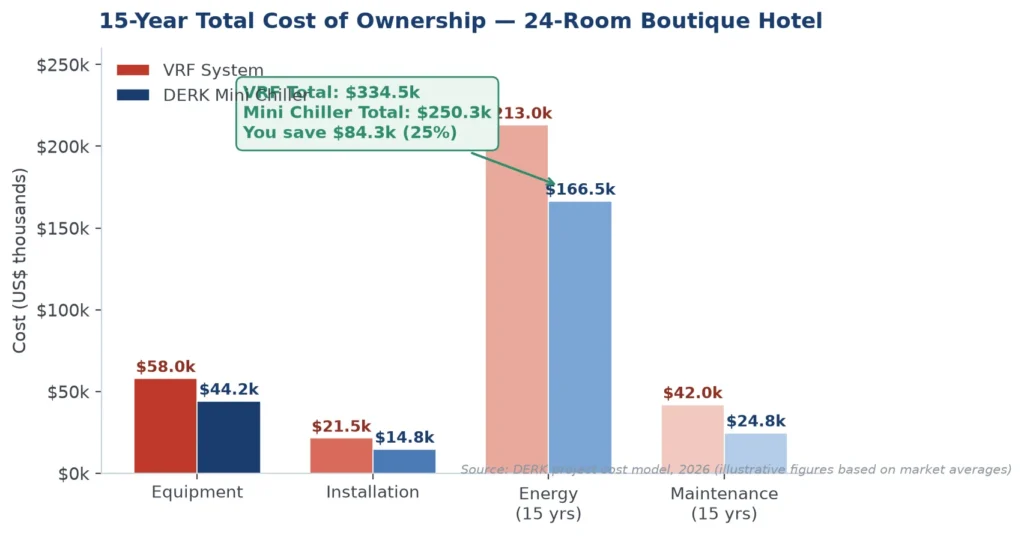
Figure 3. 15-year total cost of ownership breakdown — 24-room boutique hotel project.
The difference: $84,250 over 15 years — nearly the cost of one year’s gross revenue for a property this size.
For hotels, the mini chiller advantage compounds:
Modular expansion = phased investment. The DERK system supports up to 8 modules connected in parallel (max 240kW cooling, 32 indoor terminals). The owner installed 2 modules in Phase 1 (guest rooms) and added the 3rd module 6 months later when the spa and restaurant opened — preserving cash flow during construction.
Lower refrigerant charge = lower environmental risk and cost. VRF systems circulate refrigerant throughout the entire building — a single leak can lose the entire charge and requires expensive leak detection and recharge. A mini chiller keeps refrigerant contained in the outdoor unit; water circulates indoors. The DERK DMC-V28 uses only 4.0kg of R32 refrigerant per module.
Simpler maintenance = less downtime. Hotel HVAC failures directly impact guest satisfaction and revenue. Mini chiller water systems use standard components (pumps, filters, valves) that any local technician can service. VRF systems require brand-specific diagnostic tools and certified technicians — in a market like Chiang Mai, that means waiting 48+ hours for a service call from Bangkok.
R32 refrigerant = future-proof compliance. R32 has 67% lower global warming potential (GWP) than R410A, the refrigerant still used in many VRF systems. As Southeast Asia tightens F-gas regulations, R32 systems avoid costly retrofits or phase-out restrictions.
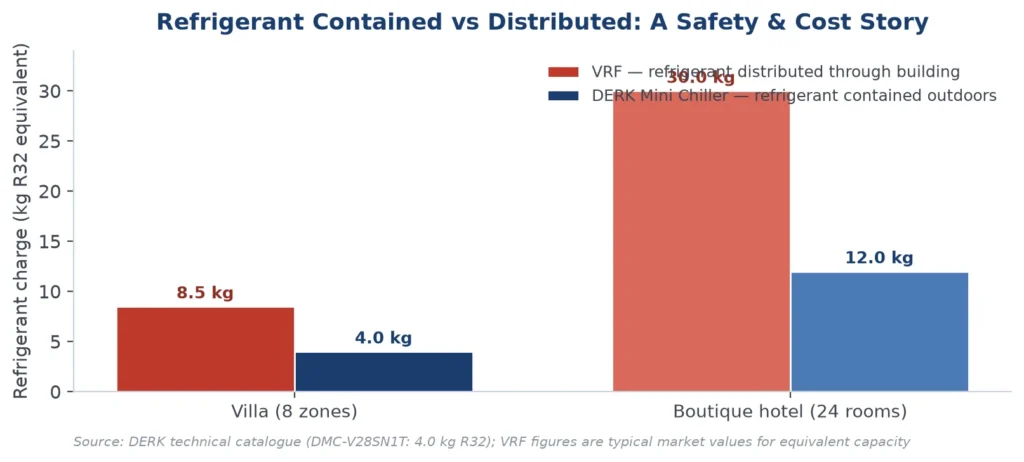
Figure 4. Refrigerant contained vs distributed — a mini chiller keeps the full charge safely in the outdoor unit.
Side-by-Side: The 15-Year TCO at a Glance
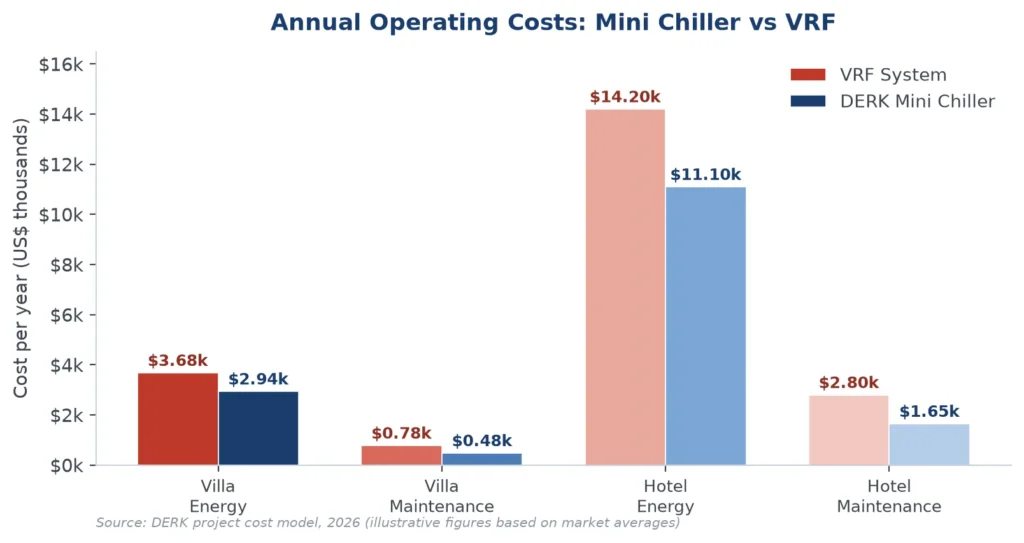
Figure 5. Annual operating costs (energy + maintenance) — the mini chiller runs cheaper every single year.
| Metric | VRF System | DERK Full DC Inverter Mini Chiller |
| Typical upfront cost (villa, 6–8 zones) | $28,000 – $38,000 | $20,000 – $28,000 |
| Typical upfront cost (small hotel, 20–30 rooms) | $70,000 – $100,000 | $52,000 – $72,000 |
| Installation complexity | High (refrigerant piping, vacuum charging) | Low (standard water piping) |
| Annual energy cost (villa) | $3,200 – $4,200 | $2,500 – $3,200 |
| Annual maintenance (villa) | $600 – $900 | $350 – $550 |
| Refrigerant type | R410A (most models) / R32 (newer) | R32 (standard) |
| Noise level (outdoor unit) | 52–60 dB(A) | 50–55 dB(A), optional Night Silence Mode |
| Heating capability | Heat pump models available | Standard (heating to -25°C ambient, 60°C water outlet) |
| Underfloor heating compatibility | Requires separate system | Native (hot water output) |
| Smart control | Brand-specific app | WiFi / 4G / Modbus, up to 256 groups |
| Expected lifespan | 12–15 years | 15–20 years |
| Certifications | Varies by brand | CE, AHRI, ErP, EUROVENT |
When VRF Still Makes Sense
To be fair, VRF isn’t wrong for every project. It remains the better choice when:
- You need individual room-by-room setpoint control with simultaneous cooling and heating in different zones (heat recovery VRF)
- Your building has extremely limited outdoor space for multiple units and a single VRF outdoor unit is the only fit
- You require very long refrigerant piping runs (up to 100m+) where water piping would lose efficiency
- The project is a large commercial building (50+ zones) where VRF’s part-load efficiency truly shines at scale
When a Mini Chiller Wins — and Wins Big
For villas and small hotels specifically, the mini chiller is the more economical choice in the vast majority of cases:
- Properties needing both cooling and heating (especially with underfloor heating) — mini chillers deliver both from one unit
- Owners focused on long-term operating cost — lower energy + lower maintenance = significant 15-year savings
- Projects in regions with technician shortages — water systems are universally serviceable
- Buildings prioritizing safety — no refrigerant circulating through occupied spaces
- Phased construction or expansion plans — modular design lets you add capacity as needed
The DERK Advantage: Engineered for This Exact Segment
DERK Climate Solutions has spent 26 years refining HVAC manufacturing, and our Full DC Inverter Mini Chiller line was specifically designed for the villa and light commercial segment — not scaled down from industrial equipment.
What sets it apart:
1. Fully Integrated Hydraulic Module
Every DERK mini chiller ships with the water pump, expansion tank, safety valve, automatic refill valve, flow switch, and Y-type filter pre-installed and factory-tested. This means:
- 30% faster on-site commissioning
- No mechanical room required
- Zero risk of mismatched components from different suppliers
2. Full DC Inverter Everything
Not just the compressor — the fan motor and water pump are also DC inverter-driven. The compressor modulates from 15% to 120% of rated capacity, the pump from 20% to 130% flow. The result: EER up to 3.53 and COP up to 3.67 — among the highest in the class.
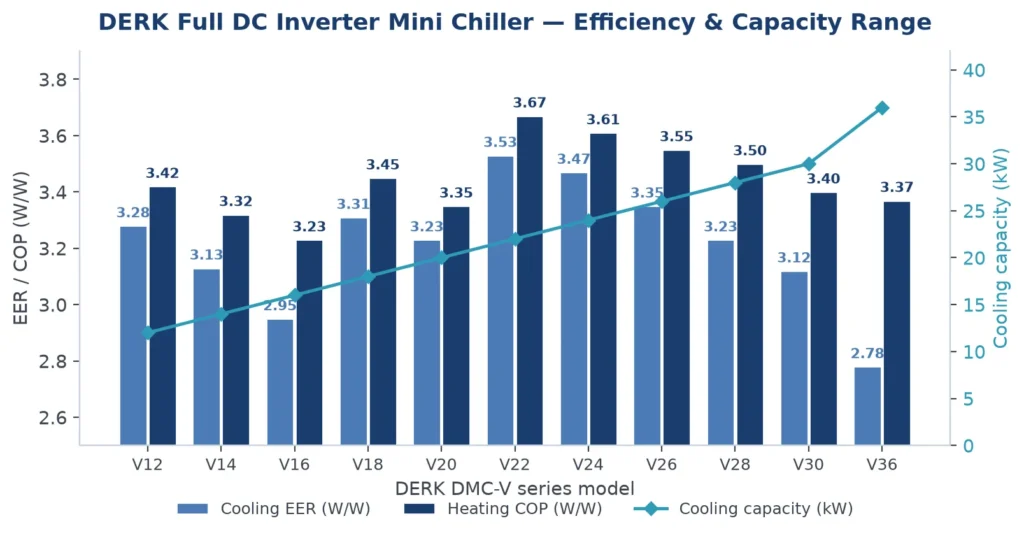
Figure 6. DERK Full DC Inverter Mini Chiller — efficiency and capacity across the DMC-V range (12–36 kW).
3. Compact Footprint, Quiet Operation
The 12–16kW models measure just 1040 × 410 × 850 mm — covering only 0.36 m² of ground space. Full-load noise is capped at 55 dB(A), with part-load operation as low as 50 dB(A). The optional Night Silence Mode further reduces compressor and fan speed for nighttime operation — critical for villas and hotels where outdoor units are near guest areas.
4. Weather Curve Intelligence
The built-in weather curve function automatically adjusts water temperature, compressor capacity, and pump operation based on real-time outdoor conditions. Independent testing shows 7–18% energy savings compared to fixed-temperature control — without any manual intervention.
5. Smart Control, Your Way
Choose WiFi wired controller, built-in 4G module, or Modbus connectivity for integration with smart home systems and BMS platforms. Up to 256 groups can be centrally monitored and controlled — perfect for hotel operators managing multiple properties.
6. Built to Last
- IPX4-rated galvanized steel cabinet with powder coating
- Hydrophilic blue-fin coils with inner-grooved copper tubes for corrosion resistance
- 10+ built-in protection functions (high/low pressure, anti-freezing, over-current, discharge temperature, water flow, and more)
- CE, AHRI, ErP, and EUROVENT certified
The Bottom Line
For villas and small hotels, the total cost of ownership comparison is no longer a debate — it’s a math problem. A full DC inverter mini chiller typically saves 20–30% on upfront investment and 15–25% on annual operating costs compared to a comparable VRF system, while delivering equivalent or better comfort, simpler maintenance, and greater long-term flexibility.
VRF remains a strong choice for specific large-scale, high-zone-count applications. But if your project is a villa, boutique hotel, small office, or restaurant — and you care about what you’ll spend over the next 15 years, not just what you’ll spend next month — the mini chiller deserves serious consideration.
Ready to run the numbers for your specific project? Contact the DERK engineering team at derkhvac.com for a free, no-obligation total cost of ownership analysis tailored to your building’s size, climate, and occupancy profile.
Tags: Mini Chiller, VRF System, HVAC Cost Comparison, Villa HVAC, Small Hotel HVAC, DERK Climate Solutions, Energy Efficient HVAC, R32 Refrigerant, DC Inverter Heat Pump